

 Partner Program
 Integrations
RCS vs SMS: Is Rich Messaging Finally Ready for Business?
What Is RCS Messaging?
What Is the Difference Between SMS and RCS?
Why Do Businesses Still Use SMS?
Why Is RCS Becoming More Relevant Now?
What Industries Benefit Most from RCS Messaging?
When Is SMS Still Better Than RCS?
Should Businesses Choose SMS or RCS?
Is RCS the Future of Business Messaging?
Still Have Questions About RCS Messaging?
For years, businesses have heard that RCS (Rich Communication Services) is the future of mobile messaging. With branded messaging, interactive buttons, verified business identities, and rich media experiences, RCS promises to modernize customer communication far beyond traditional SMS.
But despite years of industry discussion, SMS has remained the dominant business messaging channel because it is simple, reliable, and nearly universal.
So what changed? The answer is that RCS is finally becoming commercially practical — but businesses still need to understand where it fits, where SMS still wins, and why the smartest communication strategies now involve both channels working together.
What Is RCS Messaging?
RCS (Rich Communication Services) is a next-generation mobile messaging protocol that allows businesses to deliver interactive, app-like messaging experiences directly inside a customer’s native messaging application.
Unlike traditional SMS, RCS messaging supports:
- Verified business profiles
- Branded sender identities
- Logos and rich media
- Images, videos, and product carousels
- Suggested replies and interactive buttons
- Delivery confirmations and read receipts
- Clickable calls-to-action (CTAs)
- Interactive customer journeys without requiring an app download
In simple terms, SMS is text communication. RCS is conversational customer engagement. Or as VVPUSA’s Rob Moody describes it: “MMS on steroids.”
What Is the Difference Between SMS and RCS?
The biggest difference between SMS and RCS is the customer experience.
SMS focuses on reach and reliability. RCS focuses on richer interaction and branded engagement.
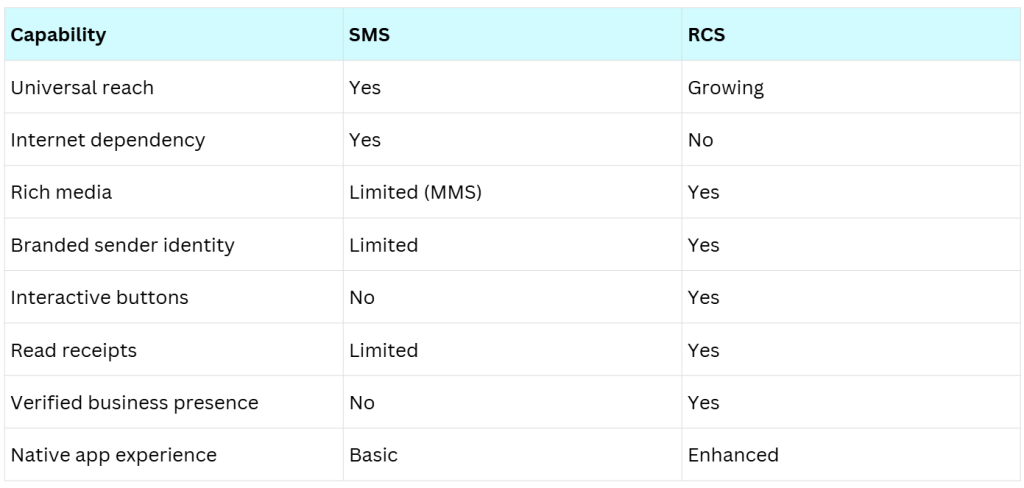
While RCS offers a significantly more modern experience, SMS still maintains an advantage in compatibility and operational reliability.
Why Do Businesses Still Use SMS?
SMS continues to dominate business communications because it solves one critical problem extremely well: reaching customers quickly and reliably.
Businesses still heavily rely on SMS for:
- Appointment reminders
- Authentication codes and one-time passwords
- Payment alerts
- Shipping notifications
- Customer service updates
- Time-sensitive operational messaging
SMS works on virtually every mobile device, requires no app installation, and does not depend on internet connectivity. For high-urgency communication, simplicity often wins.
Why Is RCS Becoming More Relevant Now?
RCS has existed for years, but adoption remained slow due to fragmented carrier support, inconsistent device compatibility, and low customer awareness.
Apple Support Is Accelerating Adoption
Historically, one of the biggest obstacles to RCS adoption was the divide between Android and Apple ecosystems.
As broader ecosystem support expands, businesses can increasingly view RCS as a legitimate messaging channel rather than a niche Android-only experience.
This does not mean universal parity overnight, but the market direction is significantly clearer than it was five years ago.
Customer Expectations Have Changed
Modern consumers increasingly expect mobile communication to feel visual, seamless, and intuitive.
A plain text message may still work, but interactive branded messaging often creates a more trustworthy and frictionless customer experience.
The customer experience standard has evolved.
Trust and Sender Identity Matter More Than Ever
Spam, phishing, and message filtering have changed how customers interact with business messaging.
Consumers are increasingly hesitant to engage with unknown senders.
RCS helps businesses address this challenge through:
- Verified sender identity
- Branded business profiles
- More transparent customer interactions
In many industries, trust may become one of the biggest drivers of RCS adoption.
What Industries Benefit Most from RCS Messaging?
RCS is especially valuable when customer engagement benefits from richer interaction and visual experiences.
Retail and Ecommerce
RCS can support:
- Product recommendations
- Abandoned cart reminders
- Flash promotions
- Store locator experiences
- Interactive shopping journeys
Financial Services
RCS helps financial institutions deliver:
- Payment reminders
- Fraud alerts with verified branding
- Customer onboarding workflows
- Application status updates
Travel and Hospitality
RCS improves mobile engagement through:
- Booking confirmations
- Check-in reminders
- Itinerary updates
- Upsell opportunities
Customer Support
Businesses can create:
- Guided self-service experiences
- Interactive troubleshooting
- Escalation pathways
- Faster customer resolution flows
These richer customer interactions are where RCS creates the most value.
When Is SMS Still Better Than RCS?
Despite the excitement around RCS, SMS remains the better operational choice in many real-world business scenarios.
SMS still wins when:
- Universal delivery is critical
- Internet dependency creates friction
- Simplicity matters more than visual experience
- One-time passwords or urgent alerts are required
- Device compatibility is uncertain
For many operational communications, SMS remains the safest and most dependable channel.
Should Businesses Choose SMS or RCS?
The smartest messaging strategies are not built around choosing one channel over the other.
They are built around customer journeys.
SMS provides dependable reach. RCS provides richer engagement where supported. Together, they create a stronger communication strategy that balances reliability, customer experience, and trust.
Businesses that treat this as an “SMS vs RCS” debate may be asking the wrong question entirely.
Is RCS the Future of Business Messaging?
RCS is no longer just an interesting industry concept.
It is becoming a practical next step in business messaging evolution.
But the real opportunity is not simply richer media. It is the ability to create:
- More trusted customer interactions
- Verified business communications
- More intuitive engagement experiences
- Reduced customer friction
- Stronger brand confidence
Whether RCS is right for your business depends on your infrastructure, customer base, communication goals, and operational requirements.
The bigger question is this:
Will your messaging strategy be ready when your customers expect richer and more trusted mobile experiences?
Still Have Questions About RCS Messaging?
Businesses evaluating RCS often ask:
- How does RCS impact deliverability?
- Does RCS replace SMS?
- What industries benefit most from RCS?
- How does verified sender identity work?
- What infrastructure is required for RCS adoption?
- How should businesses balance SMS, MMS, and RCS together?
At VVPUSA, we help businesses evaluate messaging strategies based on customer experience, compliance, operational reliability, and long-term scalability.
If you are exploring RCS, SMS modernization, or omnichannel customer engagement, we are happy to provide a consultation tailored to your business needs. Reach out via Contact@vvpusa.net.


