

 Partner Program
 Integrations
What Are the Opt-In Requirements for A2P Messaging?
A Quick Comparison of 10DLC, WhatsApp, RCS, Short Codes, and Toll-Free SMS
What Are the Opt-In Requirements for A2P Messaging?
Do All Messaging Channels Require Opt-In?
Opt-In Requirements Across A2P Messaging Channels
What Is the Difference Between 10DLC and Short Code Opt-In?
Does WhatsApp Require User Opt-In?
What Is RCS Messaging Consent?
Why Managing Opt-In Across Channels Is Challenging
Best Practices for Managing Messaging Opt-In
The Future of Messaging Compliance
A Quick Comparison of 10DLC, WhatsApp, RCS, Short Codes, and Toll-Free SMS
Businesses increasingly rely on Application-to-Person (A2P) messaging to communicate with customers through channels like SMS, WhatsApp, Messenger, and RCS. However, one of the most important steps for brands to launch a successful A2P messaging is to understand if and how their customer opt-ins should be captured.
Different messaging channels have different consent requirements, registration processes, and enforcement policies. And in different countries, the requirement can be different too. A consent workflow that works for one channel in one country may not meet the requirements of another.
Understanding how opt-in works across these channels is essential for building an omnichannel messaging strategy that is both effective and compliant.
What Are the Opt-In Requirements for A2P Messaging?
The opt-in requirements for A2P messaging vary depending on the messaging channel.
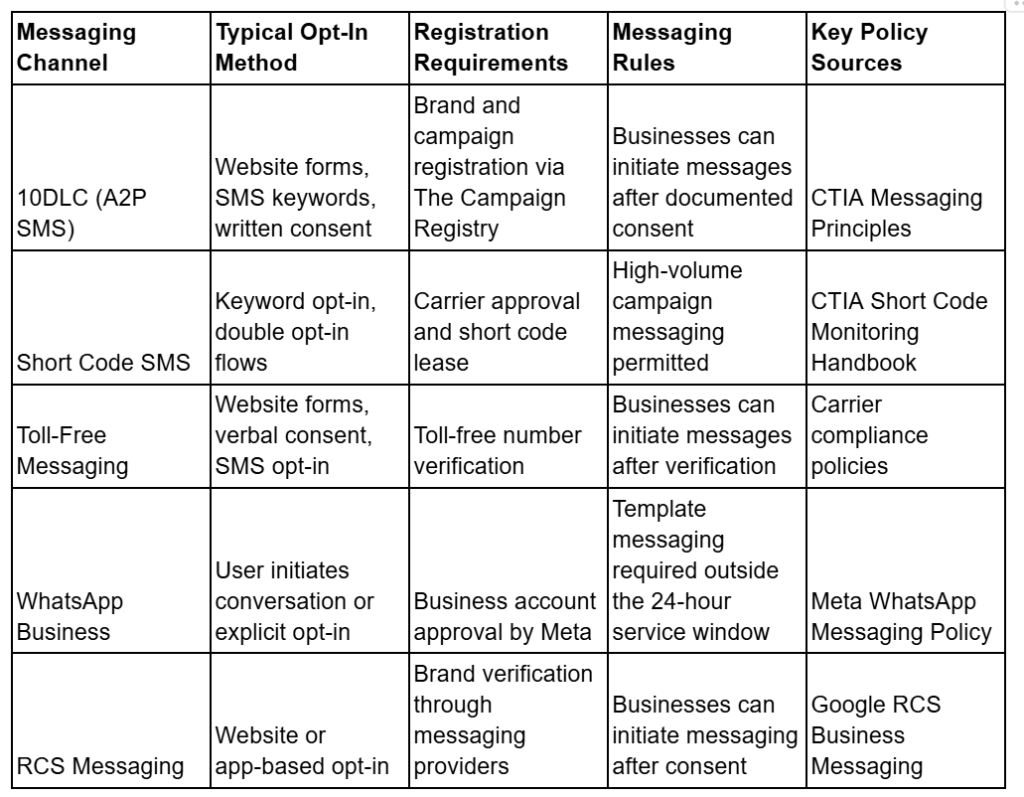
In North America, SMS-based channels such as 10DLC, short codes, and toll-free messaging generally require businesses to obtain explicit consumer consent before sending messages. Platforms like WhatsApp require users to initiate conversations or provide opt-in through approved messaging flows, while RCS messaging follows similar consent requirements to SMS combined with brand verification.
Organizations must capture and store proof of consent, including the time, method, and disclosure presented to the user, in order to comply with messaging policies and regulations.
Do All Messaging Channels Require Opt-In?
Yes. All major messaging channels require user consent before businesses send messages. However, please check with your provider just to make sure.
While opt-in is required by all channels, the method for collecting and validating consent differs across platforms.
For example, SMS messaging often uses web forms or keyword opt-ins, WhatsApp relies on user-initiated conversations or approved opt-in flows, while RCS requires user consent combined with brand verification.
Failure to properly capture consent can lead to message filtering, campaign suspension, or regulatory risk. Fines and brand erosion is not what you want by ignoring the opt-in requirement or not doing it right.
Industry guidelines published by organizations such as CTIA and regulatory frameworks such as the Telephone Consumer Protection Act define many of the standards governing messaging consent in the United States.
Opt-In Requirements Across A2P Messaging Channels
The following table compares how opt-in works across major A2P messaging channels. Please use this is a general guideline and make sure to double check with your provider or click on the reference links we listed in this article.
What Is the Difference Between 10DLC and Short Code Opt-In?
Both 10DLC and short codes are most common SMS messaging types in the North America, but their compliance frameworks are not the same. If you want to run a campaign with both Short Code and 10DLC, you may need to take care of each type of opt-in separately. It can be time-consuming but there are providers who can help you speed up the process.
10DLC messaging requires brand and campaign registration through The Campaign Registry, where businesses must describe their messaging use cases, consent flows, and message content.
Short code messaging, by contrast, is designed for high-volume campaigns and often uses keyword-based opt-in flows, where users text a specific keyword to subscribe.
Short codes are monitored through compliance programs developed by CTIA to ensure messaging practices follow industry guidelines.
Does WhatsApp Require User Opt-In?
Yes. Businesses must obtain user consent before sending WhatsApp messages.
In many cases, the customer initiates the conversation first, which establishes the initial messaging window. Businesses can respond freely during the 24-hour customer service window, but outbound notifications outside that window typically require pre-approved message templates. WhatsApp Business Messaging has a specific opt-in workflow guide for brands to consider. If proper opt-in is not obtained and users start flagging spam, brands may encounter reduced traffic volume cap per day as consequences.
What Is RCS Messaging Consent?
RCS messaging operates similarly to SMS from a consent perspective.
Businesses must collect user permission before sending messages and typically complete brand verification through their messaging provider.
The RCS ecosystem, supported by Google, enables richer messaging features such as branded sender identities, images, and interactive buttons.
However, businesses must still follow consent practices similar to those used in traditional SMS messaging.
Why Managing Opt-In Across Channels Is Challenging
As companies adopt multi-channel messaging strategies, managing consent becomes increasingly complex.
Each channel has its own:
- registration process
- opt-in format
- compliance monitoring rules
- enforcement mechanisms
Without centralized visibility into consent records, businesses may struggle with:
- inconsistent opt-in documentation
- campaign approval delays
- increased risk of message filtering
- regulatory exposure
- financial fines
- brand erosion
Best Practices for Managing Messaging Opt-In
Organizations can reduce compliance risks by implementing a structured approach to opt-in management.
- Capture explicit consumer consent. Clearly disclose brand identity, message purpose, frequency, and opt-out instructions before sending messages.
- Maintain verifiable consent records. Store timestamped proof of opt-in, including how and where the consent was captured.
- Provide clear opt-out mechanisms. Allow users to easily unsubscribe, such as replying STOP to SMS or using unsubscribe options within messaging apps.
- Standardize opt-in workflows across channels. Use consistent consent processes across messaging channels to avoid fragmented records and operational complexity.
- Monitor compliance and messaging performance. Track delivery performance, complaint rates, and opt-out trends to identify potential compliance risks early.
The Future of Messaging Compliance
As messaging ecosystems expand across SMS, OTT platforms, and emerging channels like RCS, compliance management is becoming more complex.
Organizations that rely on messaging for customer engagement must move beyond manual consent tracking and adopt systems capable of managing opt-in across multiple channels while maintaining verifiable records.
A well-designed compliance framework not only protects businesses from regulatory risk but also enables messaging programs to scale confidently as new channels emerge.


